Inheritance
Prerequisites: Encapsulation
Where this fitsThis is the third step in object-oriented programming, following Classes & Objects and Encapsulation. Real applications are built from many classes that relate to one another. This note covers the two main relationships between classes, aggregation and inheritance, what inheritance actually passes down, how
superreaches a parent, and the five forms inheritance can take.
Large applications rarely have one class. A food-delivery site might have separate classes for users, restaurants, payments, and delivery, and those classes relate to each other. Two relationships matter most: aggregation, where one class owns another, and inheritance, where one class reuses another. This note builds both, then covers what inheritance passes down, the super keyword, and the five kinds of inheritance.
Aggregation
Aggregation is a “has-a” relationship: one class owns another as one of its parts.
- A
Customerhas anAddress. - A
Restauranthas aMenu.
The owner stores an object of the owned class as one of its attributes.
class Address:
    def __init__(self, city, pincode, state):
        self.__city = city
        self.pincode = pincode
        self.state = state

    def get_city(self):
        return self.__city

class Customer:
    def __init__(self, name, gender, address):
        self.name = name
        self.gender = gender
        self.address = address       # an Address object lives here
To build a Customer, first build an Address and pass it in:
addr = Address('Gurgaon', 122011, 'Haryana')
cust = Customer('Aarav', 'male', addr)
The technical heart of aggregation: you create the main object with another class’s object passed in as input.
WarningAggregation does not grant access to the owned class’s private data. If
Addressmakescityprivate (__city), theCustomercannot read it directly; it must go through the owned object’s getter,self.address.get_city(). Owning a class is not the same as bypassing its encapsulation.
A method on the owner can delegate work to the owned object rather than doing it all. If a customer edits their profile, the name changes on Customer, but the address-editing logic belongs on Address and is called through the address object. Each class keeps the code that is properly its own.
Inheritance
Inheritance is an “is-a” relationship, and the most important idea in this note. It is borrowed from the real world, where whatever belongs to a parent belongs to the child, and traits pass from parents to offspring through DNA.
In code, inheritance creates a parent class and a child class so a child object can use the parent’s data and methods as its own. Declare it by naming the parent in parentheses after the child.
class User:
    def __init__(self):
        self.name = 'Aarav'

    def login(self):
        print('login')

class Student(User):     # Student is a child of User
    def enroll(self):
        print('enroll into the course')

s = Student()
s.login()    # inherited from User
s.enroll()   # its own method
The arrow of inheritance always points from child to parent.
The biggest benefit is code reusability. Suppose a platform has students and instructors, both able to log in and register. Writing that code in both classes repeats it, violating DRY (don’t repeat yourself): write once, reuse everywhere. Put the shared code in a parent User class and let both children inherit it.
                     User
             (login, register)
              /              \
         Student           Instructor
        (enroll,           (create course,
         review)            reply)
Now shared behavior lives in one place, and no code is duplicated. Recognizing what can be a parent and what can be a child is a large part of writing clean, short code.
Class diagrams
Once several classes relate to each other, a class diagram is a compact way to picture them. It is a standard notation, sometimes shown in interviews, so it is worth being able to read one.
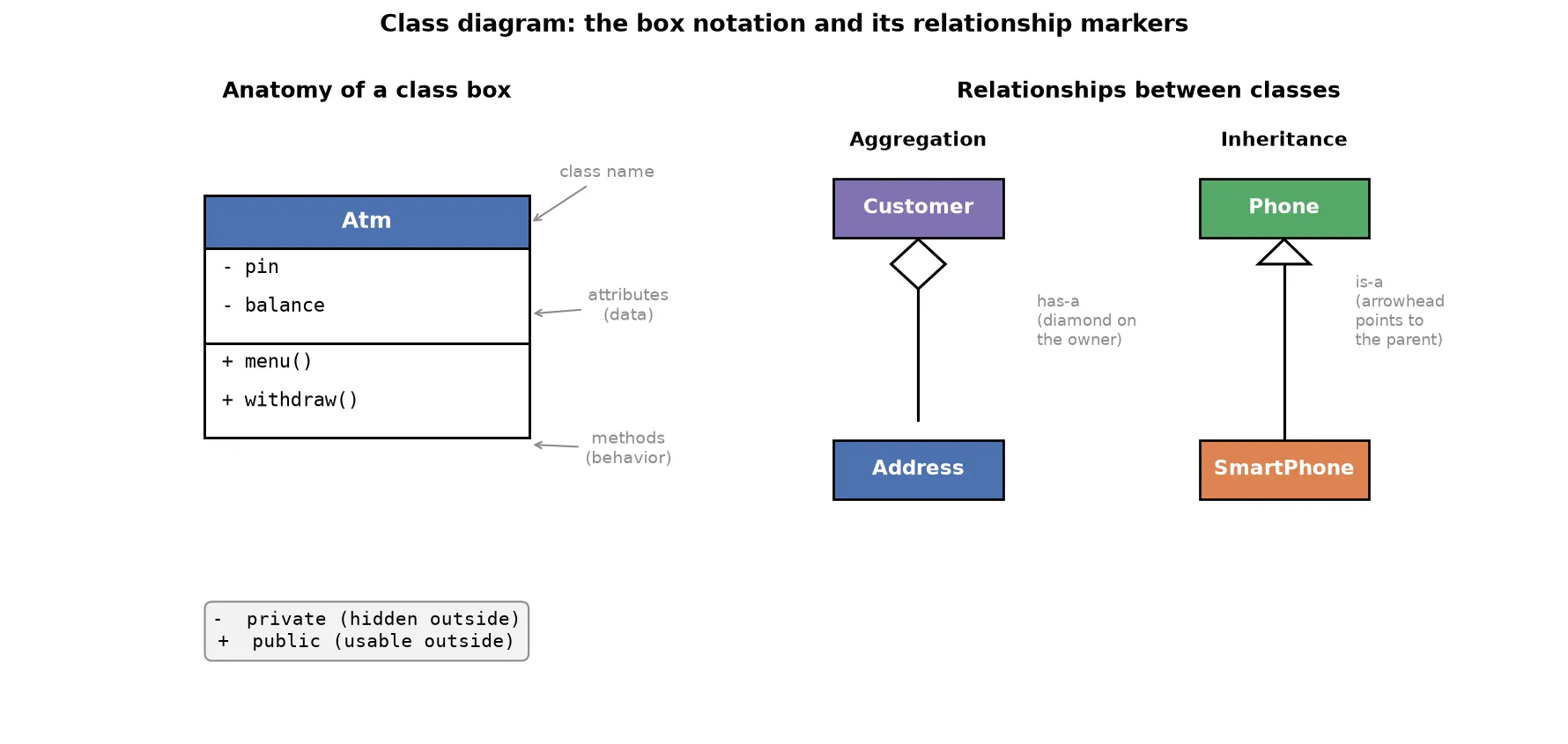
A single class is drawn as a box with three stacked parts:
- Top: the class name.
- Middle: the attributes (data).
- Bottom: the methods (behavior).
A + or - before each member marks its visibility:
-means private (hidden from outside the class).+means public (usable from outside the class).
Relationships between classes are drawn as a line with a symbol at the owning or parent end, and the symbol tells you which relationship it is:
| Relationship | Symbol at the connecting end | Meaning |
|---|---|---|
| Aggregation | a diamond (rhombus) | “has-a”; the diamond sits on the owner |
| Inheritance | a triangle (arrowhead) | “is-a”; the arrowhead points to the parent |
Reading a diagram is then quick: a diamond means one class owns another (aggregation), and a triangle means one class is a kind of another (inheritance), with the arrowhead always pointing at the parent.
What gets inherited
A child inherits three things from its parent:
- the constructor
- the non-private attributes
- the non-private methods
Private members (double-underscore names) are never inherited, though a public getter can still expose them. The subtle part is the constructor, and it comes down to one rule: which constructor runs.
Case 1: the child has no constructor. The parent’s constructor runs on child creation.
class Phone:
    def __init__(self, price, brand, camera):
        print('inside Phone constructor')
        self.price = price
        self.brand = brand
        self.camera = camera

class SmartPhone(Phone):    # no constructor of its own
    pass

s = SmartPhone(20000, 'Apple', 13)   # prints: inside Phone constructor
print(s.brand)                       # Apple
Case 2: the child has its own constructor. The parent’s constructor does not run automatically, so the parent’s attributes are never created.
class SmartPhone(Phone):
    def __init__(self):
        print('inside SmartPhone constructor')

s = SmartPhone()      # prints only: inside SmartPhone constructor
print(s.brand) # error: brand was never created| Child constructor | What runs on creation | Parent’s attributes |
|---|---|---|
| absent | the parent’s constructor | created |
| present | only the child’s constructor | not created (unless super is used) |
Case 2 is the trap that surprises people; the fix is super, below. A child also cannot reach the parent’s private members directly, but if the parent provides a getter, the child can use it, since the getter is a public method.
Method overriding
When parent and child both define a method with the same name, calling it on a child object runs the child’s version. This is method overriding.
class Phone:
    def buy(self):
        print('buying a phone')

class SmartPhone(Phone):
    def buy(self):
        print('buying a smartphone')

s = SmartPhone()
s.buy()      # buying a smartphone: the child's version wins
The constructor is itself a method, so the “which constructor runs” rule above is method overriding applied to __init__. (Method overriding is one form of polymorphism, covered fully in Polymorphism.)
The super keyword
super gives a child access to its parent’s methods and constructor. It solves Case 2, where a child’s own constructor blocks the parent’s and leaves the parent’s attributes uncreated.
The clean pattern: the child’s constructor calls the parent’s through super, passing the values the parent needs, then sets up its own extra attributes.
class Phone:
    def __init__(self, price, brand, camera):
        print('inside Phone constructor')
        self.price = price
        self.brand = brand
        self.camera = camera

class SmartPhone(Phone):
    def __init__(self, price, brand, camera, os, ram):
        print('inside SmartPhone constructor')
        super().__init__(price, brand, camera)   # run the parent's constructor
        self.os = os
        self.ram = ram

s = SmartPhone(20000, 'Apple', 13, 'Android', 8)
print(s.brand, s.os)     # Apple Android
Now both constructors run: the parent handles the common attributes, the child adds its own. This is how you split responsibility, common attributes in the parent, specialized ones in the child, while still initializing everything.
WarningTwo rules about
super:
- It is used inside the class (typically the child), never outside it, so
obj.super()from outside is invalid.- It reaches the parent’s methods and constructor, not its attributes, so
super().branddoes not work.
Types of inheritance
There are five forms.
| Form | Shape |
|---|---|
| Single | one parent, one child |
| Multilevel | a chain: grandparent to parent to child, any length |
| Hierarchical | one parent, multiple children |
| Multiple | one child, multiple parents (Python allows; Java forbids) |
| Hybrid | a combination of the above |
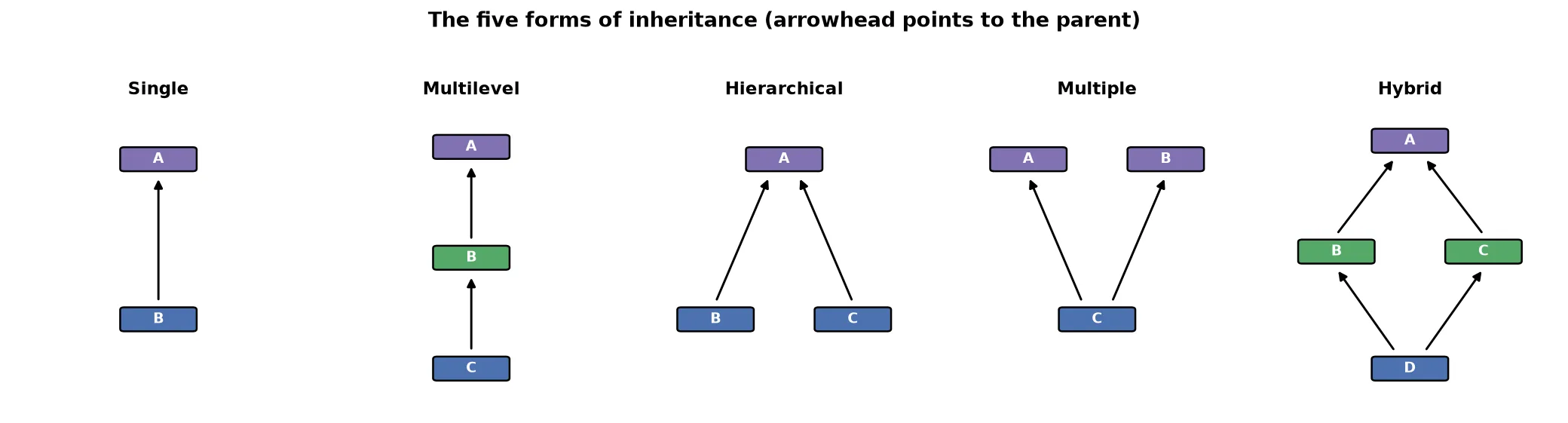
Multiple inheritance raises a problem: if a child inherits from two parents that both define the same method, which runs?
class Phone:
    def buy(self):
        print('buying a phone')

class Product:
    def buy(self):
        print('buying a product')

class SmartPhone(Product, Phone):
    pass

s = SmartPhone()
s.buy()      # buying a product
Python resolves this with the method resolution order (MRO): among the parents in parentheses, the one written first wins. Here Product precedes Phone, so Product.buy runs; swap the order and Phone.buy runs. Java cannot resolve this ambiguity and so bans multiple inheritance; Python’s MRO gives a clear, first-listed-wins rule.
WarningMethod overriding can create an infinite loop. If a method calls
self.some_method()andsome_methodis overridden to call back into the first, they invoke each other forever. Python detects this and raises “maximum recursion depth exceeded” rather than hanging.
Summary
- Aggregation is a “has-a” relationship where one class owns another, created by passing an object of the owned class into the owner’s constructor; it does not grant access to the owned class’s private data.
- Inheritance is an “is-a” relationship declared with
class Child(Parent), letting a child use the parent’s data and methods; its biggest benefit is code reusability (DRY). - A class diagram draws a class as a box of name, attributes, and methods, with
-for private and+for public members; a diamond marks aggregation and a triangle marks inheritance, its arrowhead pointing to the parent. - A child inherits the parent’s constructor, non-private attributes, and non-private methods, never its private members.
- If a child has no constructor, the parent’s runs; if the child has its own, the parent’s does not run automatically, so the parent’s attributes are not created.
- Method overriding: when parent and child share a method name, the child’s version runs on a child object; the constructor rule is this applied to
__init__. superlets a child call the parent’s methods and constructor from inside the class; it reaches methods and the constructor, not attributes, and is never used outside a class.- Inheritance comes in five forms: single, multilevel, hierarchical, multiple, and hybrid.
- Multiple inheritance is resolved by the method resolution order, where the first-listed parent wins; Java bans it for this ambiguity, Python allows it.
Continues toMethod overriding hinted at a bigger idea: the same operation taking different forms. The next note, Polymorphism, makes that precise across method overriding, method overloading, and operator overloading.
Test yourself
Quiz me is a timed test of 7 questions drawn from a pool of 14 (~6 mins, score 5+ to complete the note; miss it and it locks until review). Each attempt is a fresh mix. Flashcards is untimed recall practice over the whole pool.
Completion
Score at least 5 of 7 on the quiz above to complete this note.
Private to you, stored in this browser, never uploaded.