Tensors
Where this fitsThis note opens the linear-algebra toolkit that machine learning is built on. A tensor is the data structure every later topic sits inside, so it comes before Vectors, Matrices: Computation, and Matrices: Intuition, and it is what you feed into models like Linear Regression. There is nothing to learn first; this is where the chain starts.
Before a model can learn anything, the data has to be arranged as numbers in a fixed shape. That shape is a tensor. Libraries such as scikit-learn and the deep-learning library TensorFlow (named after this very idea) store everything as tensors, so any machine-learning or deep-learning problem means working with them. This note builds the concept from a single number up to a batch of videos, and defines the three properties, rank, axes, and shape, that describe any tensor.
What are tensors?
A dataset is useless to an algorithm until it is a block of numbers the algorithm can index. The question is how to hold those numbers so that one number, one row, a whole table, or a stack of tables all fit the same mental model.
A tensor is a container for numbers. That is the whole definition: a data structure whose job is to store numbers in a regular arrangement. It can hold characters or strings, but in practice it almost always holds numbers.
You have already used tensors under other names. A single number is a tensor, a list of numbers is a tensor, and a grid of numbers is a tensor. Mathematicians and computer scientists coined the general word tensor so that the same language covers every dimension, instead of switching terms each time a dimension is added.
Tensor and n-dimensional array are the same thingIf you come from a programming background, a tensor is an n-dimensional array (an
ndarrayin NumPy). An array is one-dimensional, an array of arrays is two-dimensional, and so on. The machine-learning community borrowed the maths word “tensor” for exactly this object, so whenever you see anndarray, read it as a tensor.
In NumPy you build a tensor with np.array, and you read how many dimensions it has from the ndim attribute. That one attribute is the practical way to tell a scalar from a vector from a matrix, as the next sections show.
0D, 1D and 2D tensors
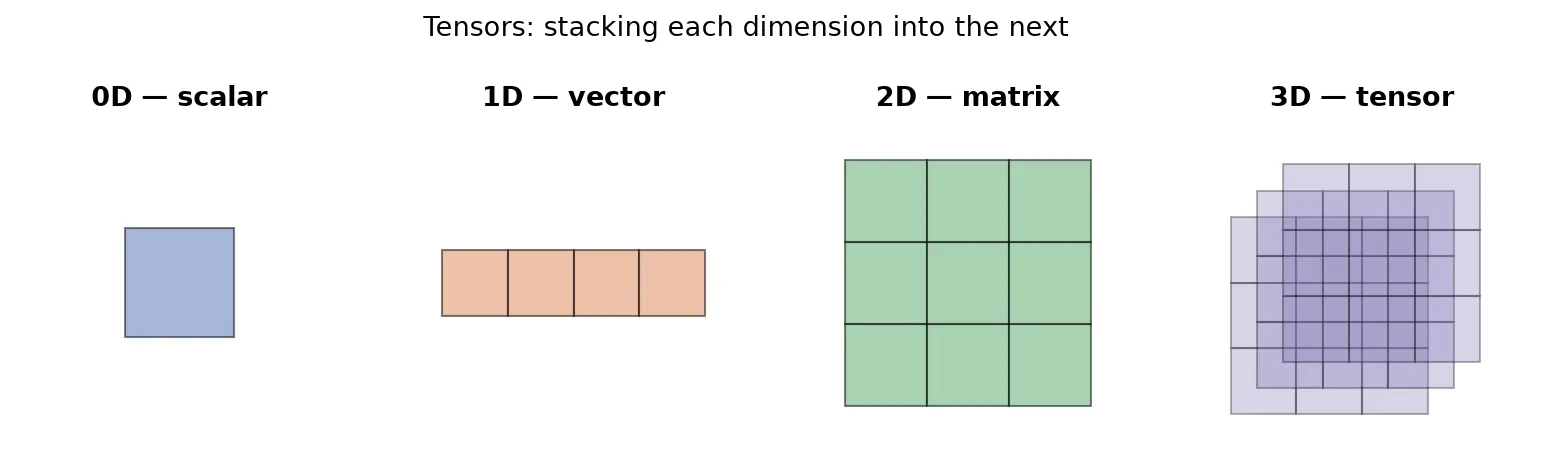
The lowest dimensions have their own familiar names. The pattern to notice is that each dimension is built by stacking several copies of the dimension below it.
- A scalar is a single number, such as
5. It is a 0D tensor: it has no dimensions, so itsndimis0. - A vector is a list of numbers, such as
[1, 2, 3, 4]. It is a 1D tensor: it has one dimension, so itsndimis1. Stacking several scalars in a line gives a vector. - A matrix is a grid of numbers arranged in rows and columns. It is a 2D tensor: its
ndimis2. Stacking several vectors gives a matrix.
import numpy as np

scalar = np.array(7)
vector = np.array([1, 2, 3, 4])
matrix = np.array([[1, 2, 3], [4, 5, 6], [7, 8, 9]])

print(scalar.ndim, vector.ndim, matrix.ndim)
0 1 2The output confirms the rule: ndim reports the tensor’s dimension directly, so a scalar reads 0, a vector reads 1, and a matrix reads 2.
ND tensors
Once the pattern is clear, higher dimensions need no new idea, only more stacking.
A 3D tensor is a stack of matrices. Picture several matrices of the same size laid one behind another to form a cuboid; the three directions are the row axis, the column axis, and a new depth axis. An ND tensor is a stack of (N minus 1) dimensional tensors, so a 4D tensor is a stack of 3D tensors, a 5D tensor is a stack of 4D tensors, and so on.
So climbing one dimension always means the same move: take several copies of the current object and line them up along a new direction. This is why there is no ceiling on dimensionality, and why a single word covers all of it.
Rank, axes and shape
Three properties fully describe any tensor. They sound similar but answer different questions, so define each carefully.
- Rank is the number of dimensions of the tensor. It equals
ndim. A matrix has rank2. - Axes are the directions along which the tensor extends. The number of axes equals the rank, so a rank-3 tensor has three axes.
- Shape is the count of items along each axis, written as a tuple. It says how many items sit in each direction.
Take a 3D tensor made of three matrices, each with 2 rows and 4 columns. Its shape is (3, 2, 4): three along the first axis, two along the second, four along the third. The total number of stored numbers is the product of the shape, so items.
import numpy as np

t = np.array([[[1, 2, 3, 4], [5, 6, 7, 8]],
              [[1, 2, 3, 4], [5, 6, 7, 8]],
              [[1, 2, 3, 4], [5, 6, 7, 8]]])

print(t.ndim, t.shape, t.size)
3 (3, 2, 4) 24A tensor’s dimension is not a vector’s dimensionThis is the single most confused point. A 1D tensor is a vector; the number of components it holds is the vector’s dimension, a separate idea. A placement record with CGPA, IQ, and state encoded as one number is a 3-component vector, so it is a 3-dimensional vector, but it is still a 1D tensor because it has only one axis. If the input had 50 columns, it would be a 50-dimensional vector living in a 50-dimensional coordinate space, yet it would remain a 1D tensor. Always separate “how many axes the tensor has” from “how many numbers the vector holds”.
Examples of 1D to 5D tensors
The dimensionality you meet in practice depends on the kind of data. Each row below pairs a dimensionality with a concrete machine-learning example and its shape, so you can recognise the structure when you see it.
| Tensor | Real data | Shape pattern | What each axis means |
|---|---|---|---|
| 1D | One data row, a feature vector | (features,) | the feature values for a single sample |
| 2D | A tabular dataset | (samples, features) | each row is a sample, each column a feature |
| 3D | NLP text or time series | (sentences, words, vector) or (days, quantities) stacked | a stack of 2D blocks |
| 4D | A batch of color images | (batch, channels, height, width) | each image is a 3D tensor of color channels |
| 5D | A batch of videos | (videos, frames, height, width, channels) | each video is a 4D tensor of frames |
A running example makes the 1D and 2D cases concrete. Suppose a student placement dataset holds CGPA, IQ, and home state (encoded as a number) per student. One student’s inputs, for instance [8.1, 91, 0], form a 1D tensor (a 3-component feature vector). Stack 10,000 such students and you have a 2D tensor of shape (10000, 3), the input table often written in machine learning. The placed-or-not column across all students is itself a 1D tensor of 10,000 values.
- 3D, text: in the bag-of-words method, each word becomes a vector, each sentence becomes a matrix of word-vectors (a 2D tensor), and a collection of sentences becomes a 3D tensor. Three sentences of two word-vectors each, where each vector has 4 components, give shape
(3, 2, 4), that is rank 3 with 24 items. - 3D, time series: data collected at a fixed interval, such as a stock’s two daily prices over 365 days, is a 2D tensor of shape
(365, 2). Ten years of it stack into a 3D tensor of shape(10, 365, 2), with the extra axis acting as a time axis. - 4D, images: a digital image is a grid of pixels, and a color image stacks three such grids (red, green, and blue channels), making each image a 3D tensor like
(3, 1200, 800). Models process images in batches, so a batch of images is a 4D tensor. - 5D, video: a video is a fast sequence of images (frames), so one video is a 4D tensor, and a batch of videos is a 5D tensor. The raw numbers grow enormous, which is why video is stored in compressed codec formats such as MP4 rather than as raw tensors.
Summary
- A tensor is a container for numbers, the core data structure of libraries like scikit-learn and TensorFlow, and the same object as an n-dimensional array (
ndimreports its dimension). - A scalar is a 0D tensor, a vector is a 1D tensor, and a matrix is a 2D tensor; each dimension is built by stacking copies of the one below.
- An ND tensor is a stack of (N minus 1) dimensional tensors, so higher dimensions need no new idea, only more stacking.
- Rank is the number of dimensions, axes are the directions (their count equals the rank), and shape is the count of items along each axis; the number of stored items is the product of the shape.
- A tensor’s dimension (its number of axes) is not the same as a vector’s dimension (its number of components): a 50-feature row is a 50-dimensional vector but still a 1D tensor.
- Common shapes run from 1D feature vectors and 2D tables through 3D text or time series, 4D image batches, and 5D video batches.
Continues toWith data now stored as tensors, the next note studies the 1D case in depth: what a vector is, the operations machine learning runs on it, and where each one shows up, in Vectors.
Test yourself
Quiz me is a timed test of 6 questions drawn from a pool of 12 (~5 mins, score 4+ to complete the note; miss it and it locks until review). Each attempt is a fresh mix. Flashcards is untimed recall practice over the whole pool.
Completion
Score at least 4 of 6 on the quiz above to complete this note.
Private to you, stored in this browser, never uploaded.